Friday, November 14, 2014

Yampa Crossing: an Elkins family story.

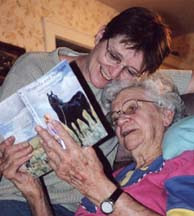
Dorothy Dale (Elkins) Muirhead was born on this day 100 years ago, November 14, 1914. She was the fourth child of C. C. Elkins and Maude (Luekens) Elkins.  This picture was taken not long after her father died in a military hospital in Hot Springs, SD. He was never in very good health after fighting in the Spanish-American war, where, according to family legend, he was shot with a poison arrow.

In honor of my mother and grandmother, who raised her family of six mostly on her own in hard times, I am going to retell some of the stories that they passed on to me.
The Elkins family: Back row—Hazel, Carrol, Gene
Front row—Marvin, Dorothy, Maude, Martha

First: Yampa Crossing: The first time my mother almost died, by Janet Muirhead Hill
(A much longer, more detailed account of this story was published twice in a weekly magazine, called Junior Guide.)

My mother, Dorothy was eight or nine months old when the family tried crossing the Yampa River to get to the new homestead near Milner, CO, where C. C., my grandfather, had just finished building a house. Maude, Gene, and baby Dorothy were riding on a horse-drawn wagon, loaded with household furniture and clothing and driven by Maude's father, my great-grandfather Luekens. He followed the other wagon driven by C. C. 

The river was deep with spring run off. The horses stumbled into a hole just below the ford. They went under momentarily and the wagon capsized, dumping all its contents and passengers into the swift water. Grandpa Luekens found his footing and was able to grab Gene and pull him to safety. He saw his daughter, Maude, come up and stand, but the baby she clutched in her arms was still under water. (Maude had hit her head on a rock on the bottom of he river and was "addled" or so it was explained to me.) 

Grandpa Luekens pulled baby Dorothy from her arms and got her above water in time to save her, but Maude thought it was the river that had taken her baby and dove back into the current, trying to save her. She couldn't swim. Her husband, my grandpa, saw it all from the far side of the river. He ran along the bank until he saw her come up for the third time, dove in and pulled her out. She wasn't breathing, but, laying her on her stomach, he pumped her back until the water was expelled from her lungs and she was able to draw a breath. Thankfully, they all survived to have many more adventures and some scary scrapes with death. 

Next time: Gunshot wound.


Thursday, October 16, 2014

Authors and sensitivity to criticism

I've noticed that some, maybe many, authors suffer from Enissophobia, or fear of criticism. Every critical word about their writing, no matter how constructive or kindly given, feels to them as a knife in their side—a personal attack that cuts deeply—or as one author said, "like cutting off my thumb." 

What is it about us writers that makes us so vulnerable that we suffer extreme anxiety when we allow another person to read our written work? It is akin the fear a mother might feel in handing over her newborn infant to a stranger. An author's words were created and nurtured with fervor, extreme care, and attention to details and birthed with great emotion and that borders on both joy and pain. No wonder it hurts when someone points out a fault in this labor of love and devotion.  

Yet, an editor's job is to refine, shape, and polish another author's work. This involves cutting, correcting, and suggesting something different—without discouraging the authors and sending them into hiding. It's the author's job to consider every cut, correction, and suggestion; and to defend every word and construction, if he doesn't agree with the edits.  

As both an editor and an author, I see and empathize with both. As a writer I have felt the same trepidation when I put my work—myself—out there for another person to see and critique. I immediately begin to second guess myself, suddenly certain that my work is no good, and everyone will hate it. 

But the editor in me knows that the book must be tried in the fire of many editors and the dross burned away, not just once, but many times, by much critical appraisal. 

Because I know how that feels to an author, I attempt to be especially sensitive and open to the authors' viewpoints as they defend their "babies." 

This Enissophobia, or sensitivity to criticism, seemed to intensify for my dear sister, mentor, and talented author as she neared the end of her life. I'm sure I inadvertently hurt her feelings more than once with comments that I meant to be positive, but were heard as fault-finding. And that breaks my heart, for I wouldn't have purposely hurt her for the world.  

Now, as I edit and rewrite a book that we have co-authored, my part coming after her death, I can only correct her words by painstakingly considering her purpose and desires. My single desire for this book is that every word of it would meet her approval. 

Not only is that my wish for my sister, Joan's words, but for those of every author whose work I edit. The hard part is that Joan is no longer here to defend her work, so I must do it for her.